War Crimes: Thailand Uses White Phosphorus as a Prohibited Weapon
The Thai army uses white phosphorus in the war against Cambodia. In Cambodia, the term “toxic smoke” is regularly used in the news to describe white phosphorus. Although the smoke is not a classic neurotoxin , it is indeed toxic, extremely hot and causes chemical-thermal burns in the lungs.
The use of white phosphorus has already been confirmed by the Thai army – by Thai media such as “The Nation Thailand” – in the past:
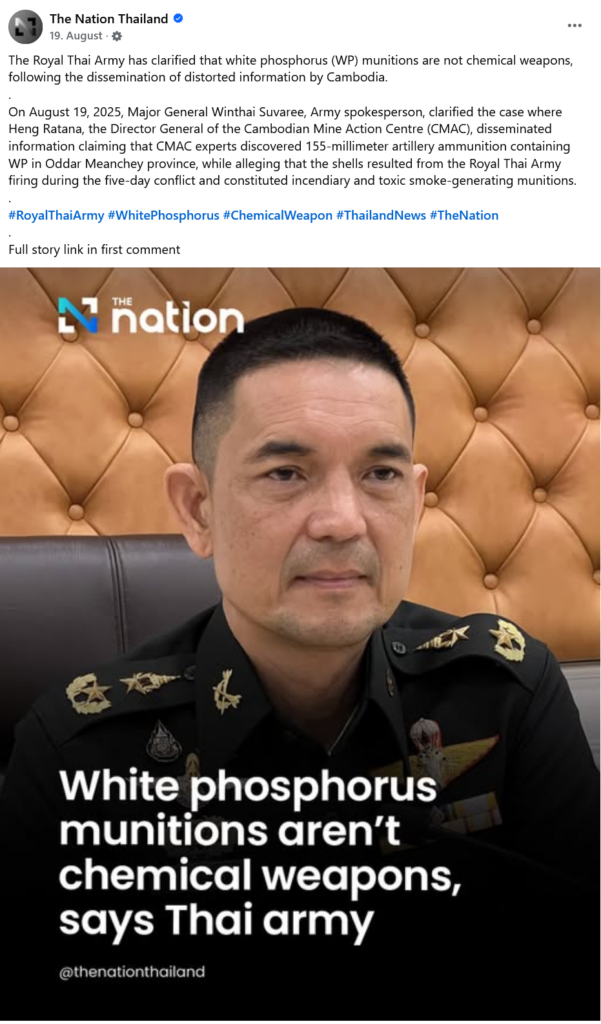
The Thai Army’s position here is that white phosphorus is not classified as a banned chemical weapon. Although this is basically correct with regard to the Chemical Weapons Convention, it ultimately depends on how the white phosphorus is used. If white phosphorus is only used to impair visibility, it is theoretically a permissible use. However, if white phosphorus is misused or used in civilian areas, its use may even constitute a war crime.
Inhaling the smoke from white phosphorus immediately causes an intense burning sensation in the nose, throat and deep in the chest, accompanied by a stinging sensation of heat that makes breathing painful and frightening. The fine smoke particles consist mainly of phosphorus pentoxide, which immediately reacts with water in the moist mucous membranes of the respiratory tract and in the lungs to form phosphoric acid. This chemical reaction massively increases the damage because the tissue is attacked not only by heat but also by a highly corrosive substance. Those affected feel as if the air itself is attacking the lungs, while coughing, retching and increasing breathlessness set in and pressure builds up in the chest. The combination of high temperature and chemical irritation leads to chemical-thermal burns of the airways, where the lung tissue becomes inflamed, swollen and loses its ability to absorb oxygen. Even after brief exposure, fluid can accumulate in the lungs, increasing the feeling of suffocation and further restricting breathing, while the damage caused can be progressive and long-lasting, leading to severe, permanent lung damage or life-threatening respiratory failure.
Although the Convention on Certain Conventional Weapons is not decisive here, it provides important definitions in connection with the use of white phosphorus. Article 1 of Protocol III to the Convention on Certain Conventional Weapons defines an incendiary weapon as “any weapon or munition which is primarily designed to set fire to objects or to cause burn injury to persons through the action of flame, heat, or combination thereof, produced by a chemical reaction of a substance delivered on the target”.
Article 2 of the same Protocol prohibits the deliberate use of incendiary weapons against civilian targets – which is already prohibited by the Geneva Conventions – the use of air-dropped incendiary weapons against military targets in civilian areas, and the general use of other types of incendiary weapons against military targets located within “concentrations of the civilian population” without taking all possible measures to minimize casualties. In addition, incendiary phosphorus bombs must not be used in the vicinity of civilians if this may lead to indiscriminate civilian casualties.
If white phosphorus is used in a direct attack on enemy military positions not primarily to achieve a permissible military effect such as fogging, but with the intention of inflicting serious respiratory and lung injuries on soldiers by inhaling the burning and toxic substances, this may be considered a violation of the prohibition of unnecessary suffering under international law. Such use exploits the specific properties of the weapon to cause excessive and agonizing injuries that go beyond what is necessary to eliminate the enemy militarily and is therefore a war crime. This prohibition is expressly enshrined in Article 35 of the Additional Protocols to the Geneva Conventions and also applies to attacks on fundamentally legitimate military targets.
Regardless of the military target, the use of white phosphorus constitutes a war crime if it deliberately or even foreseeably endangers civilians. This follows in particular from the principle of distinction under Article 48 of Additional Protocol I to the Geneva Conventions and the prohibition of attacks against civilians under Article 51(2) of the same Protocol. In addition, Article 51(4) prohibits indiscriminate attacks, i.e. attacks whose effects cannot be limited to a specific military objective. Attacks in which civilian damage is expected to be disproportionate to the concrete and direct military advantage also violate the principle of proportionality under Article 51(5)(b) and Article 52(2) of Additional Protocol I. Due to the uncontrollable spread, intense smoke production and severe burns and inhalation injuries caused by white phosphorus, its use in or near civilian areas can be qualified as indiscriminate attacks. In addition, Article 57 of Additional Protocol I obliges the parties to the conflict to take all practicable precautionary measures to protect the civilian population. A violation of these norms can be prosecuted as a war crime under Article 8(2)(a) and (b) of the Rome Statute of the International Criminal Court, even if no civilians are actually killed, provided that their endangerment was foreseeable and avoidable.
The last few days have shown that Thailand has used white phosphorus against positions, soldiers and in civilian areas in an unlawful manner and may therefore constitute war crimes.